• Home
  • Blog (Practice Videos)
  • Centering Movement
  • Thinking Feelingly
  • Retreats
  • Published Work
  • Yoga & Poetry Classes
  • Bio
    • Contact
  • my Philly somatics studio, Shiné: Mind/BodySpirit
  SHINÉ YOGA/MOVING POETICS

MOVING POETICS BLOG
returning current

1/31/2024

0 Comments

 
Picture
Margaret Atwood, “February”​

Winter. Time to eat fat
and watch hockey. In the pewter mornings, the cat,
a black fur sausage with yellow
Houdini eyes, jumps up on the bed and tries
to get onto my head. It’s his
way of telling whether or not I’m dead.
If I’m not, he wants to be scratched; if I am
He’ll think of something. He settles
on my chest, breathing his breath
of burped-up meat and musty sofas,
purring like a washboard. Some other tomcat,
not yet a capon, has been spraying our front door,
declaring war. It’s all about sex and territory,
which are what will finish us off
in the long run. Some cat owners around here
should snip a few testicles. If we wise
hominids were sensible, we’d do that too,
or eat our young, like sharks.
But it’s love that does us in. Over and over
again, He shoots, he scores! and famine
crouches in the bedsheets, ambushing the pulsing
eiderdown, and the windchill factor hits
thirty below, and pollution pours
out of our chimneys to keep us warm.
February, month of despair,
with a skewered heart in the centre.
I think dire thoughts, and lust for French fries
with a splash of vinegar.
Cat, enough of your greedy whining
and your small pink bumhole.
Off my face! You’re the life principle,
more or less, so get going
on a little optimism around here.
Get rid of death. Celebrate increase. Make it be spring.

Margaret Atwood, “February” from Morning in the Burned House. Copyright © 1995 by Margaret Atwood. Used by permission of Houghton Mifflin Company. All rights reserved.
 
 
Tamiko Beyer, “February”

I’m climbing out of this season, fingernails ragged, belly soft. I tuck a stem of dried mint behind my ear to remind myself.
 
Once, I bared my shoulders. The bottom of my feet roughed up the dirt with their hard calluses. When I harvested arugula, it smelled of green spice—alchemical veins pulsing sun and dirt and water. I do remember this. I pinned summer light up in my hair and made no apologies for the space I took up—barely clothed and sun-bound.
 
Now, a ball of twine in the grey sky. The sun rolls low on the horizon. Hangs. Then dips back down again, wind howling us into night.
 
Inside the erratic rhythm of this wavering flame, I conjure the potent sky of the longest day. Seeds with a whole galaxy inside them. Cicadas vibrating in the alders.
 
But the sensation of joy slips too quickly into simulacra. Song on repeat. I never meant to find myself in such a cold place, my hair thinning against winter.
 
Once, red clover grew thick where today’s rabbit tracks pattern the snow. Clover said flow, clover said nourish, clover said we’ve got this.
 
I reel the memory out, let it linger on the horizon, then reel it back in. I play it out and reel it back in. Some kind of fishing, some kind of flying—again and again. I loosen the buckles of my mind. I take up space in the precision of my breath. I call us all back in.

Copyright © 2022 by Tamiko Beyer. Originally published in Poem-a-Day on January 31, 2022, by the Academy of American Poets. Reprinted by permission of the poet.
 
 
POETIC THEMES
            This is a big turning point! Halfway through winter, this week marks the very beginning of spring renewal. Neo-paganism, claiming to draw from traditions reaching back as far as Sumerian and Egyptian cultures, celebrates Imbolc (arguably from the old Irish, “in belly,” referring to the pregnant ewes). The Gaelic tradition of St. Brigid’s Day honors the Christian saint associated with fertility. Groundhog Day calls upon animal wisdom to intuit just how long the icy days will last. Maybe all this celebrating doth protest too much… February, the very heart of winter, sometimes feels like Atwood’s “month of despair,” and most of us relate to the big smoke signal of her last line, “make it be spring.” If that’s where the poem ends, it begins by rhyming “dead” “head” and “bed” and the wonderful, irreverent line, “Winter. Time to eat fat.” We can all relate to this particular form of in-belly-Imbolc, which Atwood shamelessly extends from a craving for vinegar fries to the notion of eating our own young.
           The repetitive, insistent striving for a hockey goal—“Over and over / again, He shoots he scores!”—models a hopeful, if desperate, scooping up of the life principle. Humor, irreverence, and reoriented priorities aren’t just respite from the gloom, but part of a staunch belief in the possibility of renewal. Not much is as simple and quick as the sudden lift we get from a laugh. Chuckling at a cat’s pink bumhole is a radical practice that enthrones life and love in the face of all the forces that drag us toward stagnancy right now. Atwood’s cat and Pennsylvania’s own Punxsatawney Pete are undercover agents of the life force, which is stubbornly building somewhere underground. We may all have, like the month of February, “a skewered heart in the center,” but it continues to beat. Political climate irrevocably screwed? Covid got ya quarantined? A good belly laugh scoops the Imbolc right up into the heart. It’s love, Atwood tells us, that does us in and by implication saves us (from eating our young among other things). We can still cling to hope, as she does when she commands her cat to make it be spring already.
            The current of death rising back up toward renewal is configured differently in Tamiko Beyer’s “February.” Instead of externalizing the life principle as an animal, she herself embodies a human-out-of-hibernation beast: “I’m climbing out of this season, / fingernails ragged, belly soft.” The stem of mint behind her ear “to remind myself” transports us along with her back to warmer times. Spring starts in the roots: feet, dirt, and arugula’s “alchemical veins / pulsing sun and dirt and / water.” Deep down in the veins of the earth, underground interactions of sun, dirt, and water are creating new life. This elemental alchemy is central to Chinese medicine, in the transition from winter, governed by water, to the wood element of spring seeds and saplings. Wood stands in not just for vague hopes and dreams taking shape in the manifest realm, but also stands for the very principle of expansion and potential.
         The poem’s form mimics the way the stubborn, halting life principle is striving to expand and rise, continually swatted down by frost. After the introductory stanza about emergence and memory, each stanza takes us through the swing between past and present. Beginning with one word that throws out a marker of time like “Once” or “Now,” each section throws out some warm-weather phenomenon to be reversed by winter: “I pinned summer light up in my hair” becomes “in such a cold / place, my hair thinning / against winter.” Or winter hopelessness is reeled back in, as when rabbit tracks in the snow yield to the memory of red clover, murmuring hopeful encouragement about flow and nourishment and grit. We rise and fall with each stanza through “sunbound” summer memories reaching upward toward the “potent sky of the longest day,” down via the low, hanging winter sun that “rolls low on the / horizon” and “dips / back down again.”
            The final stanza of “February” offers a meta-reflection on these reversals, capitalizing on Beyer’s image of the sun as a ball of twine. Here at the end of the poem the metaphor appears fully developed: “I reel the memory out, let it linger on the horizon, then reel it back in. I play it out and reel it back in. Some kind of fishing, some kind of flying—again and again.” The “erratic rhythm” makes sense now: Beyer’s poem instantiates a kind of parabola, where an object thrown out against gravity returns in a symmetrical curve. 
          Maybe the parabolic line (a fishing term) is useful for thinking about the dip-and-rise of fishing for hope this month. After two springlike days, it’s snowing outside my window as I write this. Grr. The figure of the parabola is a nice way to imaging our actual breath, bringing the poem’s abstraction into concrete embodiment. We cast the breath out and draw it back in. This rhythm of breathing is the truest moment-by-moment tether to the life principle. The comforting cadence rocks us like the soothing words of Beyer’s red clover: “we’ve got this.”
 
 
PRACTICE
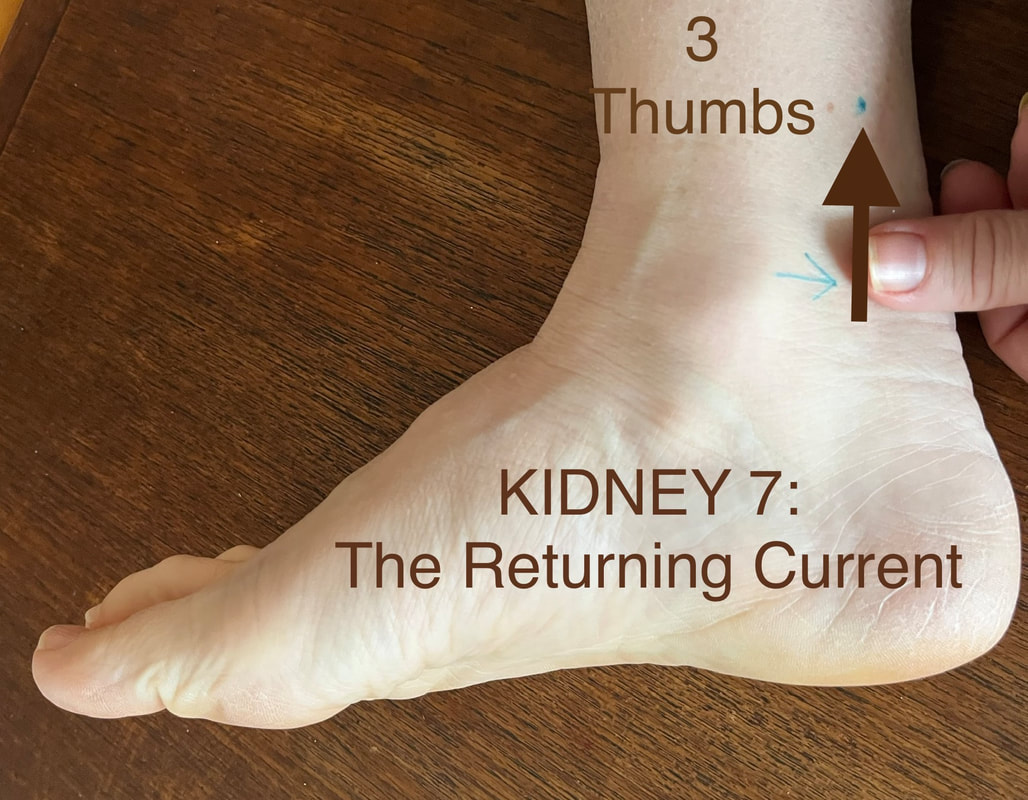
            How might we facilitate the returning current and, in Atwood’s turn of phrase, “get going / on a little optimism around here”? I think of the much-quoted line from Wendell Berry: “practice resurrection.” Here’s a resurrection practice for stimulating the parabolic turn in the energy system, dipping down to rise back up like Beyer’s fishing line. The Returning Current acupressure point relates to Hexagram 24 of the I Ching, which describes a turning point after a time of decay. Banished light returns. There is movement without force. The old is transformed and the new is introduced. Also known as Kidney 7, this acupressure point helps the downward energy turn around and ride back up toward the torso. Related to the power of rebirth, the physical point is used to stimulate childbirth. And isn’t the crowning of a baby’s head the perfect manifestation of spring, new life emerging from the mysterious darkness of the birth canal? Stimulating this acupressure point, about two thumbprints up from the inner ankle bone, might help renew the feeling of upward current. As you tenderly knead this spot, you might visualize loops of breath around the torso, inhaling from the pelvic floor up the spine and around the top of the skull, like reeling in the thread of energy, and exhale it down the front, as if playing out the fishing line again. 
            *Also* you might just need the remedy of laughter. I hate to say locking into a screen counts as embodied practice, but if you can’t watch a cat (or some other living thing you associate with the life principle), you might hunt for a few funny online videos of your favorite creature to study its magic. Does this beast have a superpower that might help you through the last bitter weeks of winter?
0 Comments


Leave a Reply.

    KATY HAWKINS, PHD

    A teacher of somatics, offering practices for an embodied experience of poetic language.

    Archives by season

    November 2024
    October 2024
    September 2024
    August 2024
    May 2024
    April 2024
    March 2024
    February 2024
    January 2024
    December 2023
    November 2023
    October 2023
    September 2023
    August 2023
    July 2023
    June 2023
    May 2023

    RSS Feed

home   •    bio    •    private sessions    •    public teaching    •    media   •    workshops   •   retreats    •    testimonials    •    published work   •   contact

all content ©2015